Monday, January 25, 2016

Greener and Sustainable Transportation

In most cities in Malaysia, very few people uses the bike paths.  Most users mainly cycle for recreational purposes only. In Holland, a country where cycling has become the norm, the dutch uses bicycle for their daily commuting to work, to school, to shop.. etc.. Making people leave their car at home and take public transportation still cannot be implemented in Malaysia. It has become a standard for one household to have three cars. This is also true for the lower middle income neighborhoods. We can see cars lined up the residential streets. I think we should make owning a second car expensive.. at the same time public transportation must be efficient, only then people would want to take the buses and trains. With that in place, we can hope people would cycle from home to the nearest transit station. Hmmm... it sounds like utopia at the rate we are going now.


Image Source: http://blog.publictransportation.org/category/policy/
Tuesday, August 11, 2015

PearL of WisdoM #5


EGO ??? .. certainly not the WAY to GO!

Friday, March 15, 2013

PearL of wisDom # 4

For beautiful EYES, look for the GOOD in others
For beautiful LIPS, speak only words of KINDness
......
 
- Audrey Hepburn

Thursday, September 08, 2011

Lawatan Ke Rumah Amal Yan, Kedah


Siswa-siswi Sarjana Muda Perancangan Bandar dan Wilayah Semester 07B, Sessi Disember 2010-Mei 2011 telah mengadakan program amal kommuniti semasa lawatan akademik mereka untuk projek studio Penyediaan Rancangan Tempatan Daerah Yan. Kajian tapak yang mengambil masa 6 hari bermula Isnin 7 Februari 2011 telah dipenuhi dengan pelbagai taklimat, tinjauan ke kampung-kampung, kawasan pertanian, perindustrian serta tarikan pelancongan yang terdapat disekitar daerah. Para pelajar juga menjalankan pelbagai jenis kajiselidiek mengikut keperluan silibus mereka.
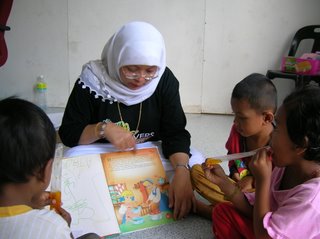
Sebelum pulang ke kampus, 28 orang pelajar berkenaan telah mengadakan program amal di Rumah Amal Yan, sebuah pusat latihan warga kurang upaya. Para pelajar telah mengumpul derma dari pelbagai pihak di UiTM untuk program amal berkenaan. Antara yang menyumbang adalah para pelajar, pensyarah dan staf Fakulti Senibina, Perancangan dan Ukur, penghuni kolej serta rakan-rakan mereka. Sumbangan juga diterima dari agensi dan individu luar. Pelbagai aktiviti diadakan bersama dengan kanak-kanak OKU yang hadir pada petang yang indah itu. Para guru-guru serta petugas Rumah Alam Yan juga turut hadir. Selepas mengikuti beberapa aktiviti, semua yang hadir menikmati sedikit jamuan yang disediakan oleh para pelajar.


Siswa-siswi kemudian menyanyikan beberapa buah lagu diikuti dengan majlis penyampaian sumbangan kepada setiap murid OKU dan barangan kepada Penyelaras Rumah Amal Yan. Penyampaian sumbangan disempurnakan oleh pensyarah pengiring, Prof madya Dr Habsah Hashim. Yang paling menyayat hati adalah disaat perpisahan apabila murid-murid OKU menyanyikan lagu "Namun ku Punya Hati" dengan cara dan kemampuan mereka sendiri. Ramai yang tersentuh dengan penyampaian bersahaja penuh ikhlas dari mereka..ramai yang menitiskan airmata... ada murid OKU yang memeluk abang-abang serta kakak-kakak yang sudi meluangkan masa untuk bermesra dengan mereka petang itu. Namun...kami harus pulang ke Shah Alam..tengah malam baru kami sampai ke kampus.


Thursday, November 04, 2010

Pearl of WisdoM # 3

Our greatest glory is not in never falling, but in rising everytime we fall
~Confucious~

Monday, November 16, 2009

LiVe LiFe


Life is not about waiting for the storms to pass...
...it's about learning how to dance in the rain!
~anonymous~

Sunday, March 08, 2009

Jejak Jogja: Lessons on Life

29 students and 3 lecturers from UiTM's Town & Regional Planning Department had gone for a study trip to Yogyakarta and Solo from 2 - 6 March 2009. During the five days trip, the group managed to forged closer ties with planning students from Universitas Gadjah Mada and made two presentations about planning system and urban design in Malaysia. Students and staff from UGM had warmly welcome the UiTM's group. The five days stay in Yogyakarta and a short day trip to Solo were not only filled with visits to interesting tourist destinations in the special region, but had also portrayed the Indonesian culture and heritage. Visting Borobudur, one of site listed in the UNESCO world heritage list as depicted in the photo above and going up to the Ketep Pass to have a glimpse of the Merapi volcano were the highlights of the trip. However, the midday rain and the fog at the mountain land made it impossible to view the volcano. See picture below.

The visit to Parangtritis beach to view the serenity of the sunset, the "andong" (horse carriage) ride to Puriwisata for dinner and watching the Ramayana theatre plus visits to royal palaces - the Mangkunegaran palace in Surakarta (Solo) & Kraton in Yogyakarta and the urban conservation site at Taman Sari had certainly made the five day's tour busy and interesting. Though the students learned a lot from the visit to UGM and the sightseeing and visiting tourist attraction places, one very important lesson that the students got from this visit is through observing the living conditions and the interactions they had with the ordinary people on the streets of Yogyakarta.

Malaysia and Indonesia might have many similarities, but had very different political system and governmental policies. As such our Indonesian cousins had not enjoy the type of development that we, in Malaysia had taken for granted. The most notable difference experienced by visitors to the Java island the moment they step out of the airport is the high density of people, compactness of the buildings and narrowness of the streets. People seems to be everywhere, some busy at work, many on the move, some are doing whatever they can to earn a living ... to the extent of begging ... and many more just seems to be doing nothing but passing time. The high proportion of poor people is reflected in the urban fabric .. for example, the trishaw that has became obsolete in Malaysian cities is still heavily used by people as cheaper means of transportation, besides being used for "wisata" (tourism) .. together with the "andong" (horse-carriage). As the world's fourth largest country in terms of population (after, China, India and USA), Indonesia certainly depicts the crisis described by Paul Earlich (1968) in his book "The Population Bomb". This is especially true in the island of Java where 60 percent of the Indonesian population stays. The government's transmigration policy that aims at bringing people to other islands like Kalimantan, Sulawesi, Sumatera etc. has not translated well in practice. Javanese would not want to leave the Java land ... no matter how difficult life is in the disaster-prone island.

The Bachelor in Town & Regional Planning 08 students who went for "Jejak Jogja" had seen how people are making whatever they can to earn a living. Surely they will not forget being chased by the "asungan" sellers at Borobudur who would be willing to offer unbelievably low prices that had tempted many students to buy the souvenirs. The ever willing "amen" singers and musician who would use anything ... from a guitar to just bottles and sticks to entertain customers along Malioboro street, in the heart of Yokyakarta. Not to mention the sad encounters with beggers on the streets. The local authority had to put up signs as below to curb the situation. Wherever we go, there will always be someone (at times many such persons) who would offer any form of service ... parking guide, crossing street etc. etc ... for a small amount of money ... just to earn a living!
The "Jejak Jogja" project initiated by the BTRP 08 (Dec'08-Apr"09) students has certainly been a fruitful effort. Besides learning the differences in the planning system, the urban form and visiting interesting tourist attractions in daerah istimewa Yokyakarta and Surakarta, the experience about life through walking the streets of Jogja is the most priceless lesson that the students could learn ... this certainly cannot be taught through lectures in the classroom. Finally, the friendship that were forged with the UGM's students & staff and also the cheerful Pak Karjo, the tourist guide and the wonderful "mas-mas" from Jom Jalan Travel had certainly made the five-days stay a memorable one.

Friday, January 23, 2009

Pearl of WisdoM # 2

A house is not a home unless it contains food and fire for the mind as well as the body.
~Benjamin Franklin~

Thursday, October 16, 2008

Human Capital

Excerpt from Professor Dr Ibrahim Abu Shah, UiTM's vice-chansellor's introductory remarks in Pearls of Wisdom ... in conjunction with UiTM's 50th. anniversary in 2006

"Our graduates can be compared to PEARLS - a precious commodity to be treasured, admired and appreciated by all. In this regard, they are also human capital of distinction, capable of attaining the highest standards of excellence in their personal development and thereby contributing to national development."

myremarks:
... to be a pearl ... what does it take? First, have a pure heart, one that has lots of love to give. Next, learn, learn and learn ... life itself is full of valuable lesson ... if only one see, hear and observe ...

Monday, August 11, 2008

Pearl of WisdoM # 1

Nearly ALL men can stand adversity, but if you want to test a man's character, give him PoweR.
~ Abraham Lincoln~

Wednesday, May 21, 2008

PeLAYARAN kITa


Ku serakkan tautan kiambang
Sebelum ku jejaki gelombang
Jika tak ku temu kekuatan
Ku ratib semangat kebangkitan
Lautan bergelora
Tidak gentar ku rempuhi
Pelayaranku,
biar tenggelam tak melara
Perjuanganku,
sinarnya membelah samudera

petikan lirik lagu Samudera nyanyian Nora, lirik ditulis oleh Ahmad Fedtri

Thursday, November 29, 2007

Moulding THE Future Human - WHO's job?

WHO knows what women can be when they are finally free to become themSELVES? WHO knows ... ? WHO knows of the possibilities of love when men and women share not only children, home and garden, not only the fulfilment of their biological roles, but the RESPONSIBILITIES and PASSIONS of the work that creates the HUMaN future.

Source: Betty Friedan (1963), The Feminine Mystique, Penguin Books, England, p.331

Thursday, August 09, 2007

Way to Live

Source: Arnold Toynbee (1970), Cities on the Move, Oxford University Press, p.247

About eight thousand or perhaps ten thousand years ago, our ancestors transformed themselves from vagrant food-gatherers, hunters, and fishermen into sedentary tillers of the soil and breeders and sheperds of livestock. Their survival of this previous testing transformation is a precedent that offers us grounds for hope that we, in our turn, may be going to survive our own ordeal. ... Since our ancestors rose to the occasion, we, their decendents, are presumably capable of emulating them if we display the courage, vision, and inventiveness that were our ancestors salvation.

Monday, July 23, 2007

shh....Let's Listen

Source: Mary King (1999), The Intuitive Voice: Your Guide to Successful Living, Ringwood, Victoria: Brolga Publishing. pp. 19-20.
Intuition and logic are two sides of the same coin. There's a place and a need for both. We need to LEARN to accept each side. Letting go judgement is the key. Judging or criticising can stop us from hearing our intuitive voice.

Let's Look


The real voyage of discovery consists not in finding new lands but in seeing with new eyes


- Marcel Proust

Thursday, June 28, 2007

NoThing is IMpossible

Source: Sheila B. Kamerman and Alfred J. Kahn (1984), Societal Learning in Work and Family: Changing Roles of Men and Women edited by Patricia Voydanoff, Palo Alto, California: Mayfield Publishing Co. p. 345


It is POSSIBLE for adults to work and still build strong families. It is POSSIBLE for mothers and fathers to share work and home responsibilities. It is POSSIBLE for them to draw upon extensive child care services to help them in this, without sacrificing any of their rights and duties as parents. All this POSSIBLE, but only if the work world, along with government and communities ADAPTS and COOPERATES

Wednesday, May 09, 2007

InDaH hari U & Me


Andai kasturi hilang harum,
Mawar tak berkuntum,
Cinta tak bersambung
Biar emas setinggi gunung,
Kan ku peluk rimbun ampun
Rahmat yang Maha Agung


Sebahagian lirik lagu Nyanyian Serambi oleh Ramli Sarip

Friday, February 23, 2007

Mother Earth ... whose responsibility?

Source: Victor R. Savage (1984), Western Impressions f Nature and Landscape in Southeast Asia, Kent Ridge: Singapore University Press, p.13

... Included in this landscape concept are both the natural landscape such as mountains, rivers, seas. swamps and jungle, and the cultural landscape, which comprises the signature of human activity and creativity such as settlements, towns, cultivated lands, ruins and transportation networks.

The qualities and properties of the environment are a product of human consciousness. It is human beings who differentiate nature by defining it, colouring it, feeling it with emotions, systematizing and ordering it, and giving it meanings.

Friday, January 26, 2007

Hope & wisH

Ref: Jerry A. Jacobs and Kathleen Gerson (2004), The Time Divide: .. Cambridge, Harvard University Press. p. 6

In the BEST of all possible worlds, neither Mothers nor Fathers would be penalized for taking care of their children. And surely such a world would not penalize women more than men.

... Mothers and Fathers alike fear that family-friendly workplace policies come with significant strings attached.


changing TIMEs

Ref: Arlie Russell Hochschild (1997), The Time Bind: .. New York: Metropolitan Books (pp: 257-258)

The TIME experiment at ESI, Xerox, and Amerco involve modest, practical adjustments whose true lesson is that our time bind is not an immutable given but something we could alter. To make such changes, however, we have to DARE to want to change.

One thing we can learn is that small groups of people can bring about changes in culture and habit that an individual would NOT dare to attempt alone.

Any successful movement for social change begins with a VISION OF LIFE as it could be, with the notion that something potential could become REAL. So let's imagine ...

Let's imagine PTA meetings to which a large majority of the parents came, libraries where working parents can afford to devote their spare time to reading or literacy programs, and community gardens in which they and their CHILDren have the leisure to grow fresh vegetables. Picture ...

BUT vision alone will not be ENOUGH. ..